Semantic Inconsistency Detection
Logic & Physics Validation
Detects logical inconsistencies like incorrect shadows, impossible perspectives, distorted reflections, and violations of physical laws that AI often produces.
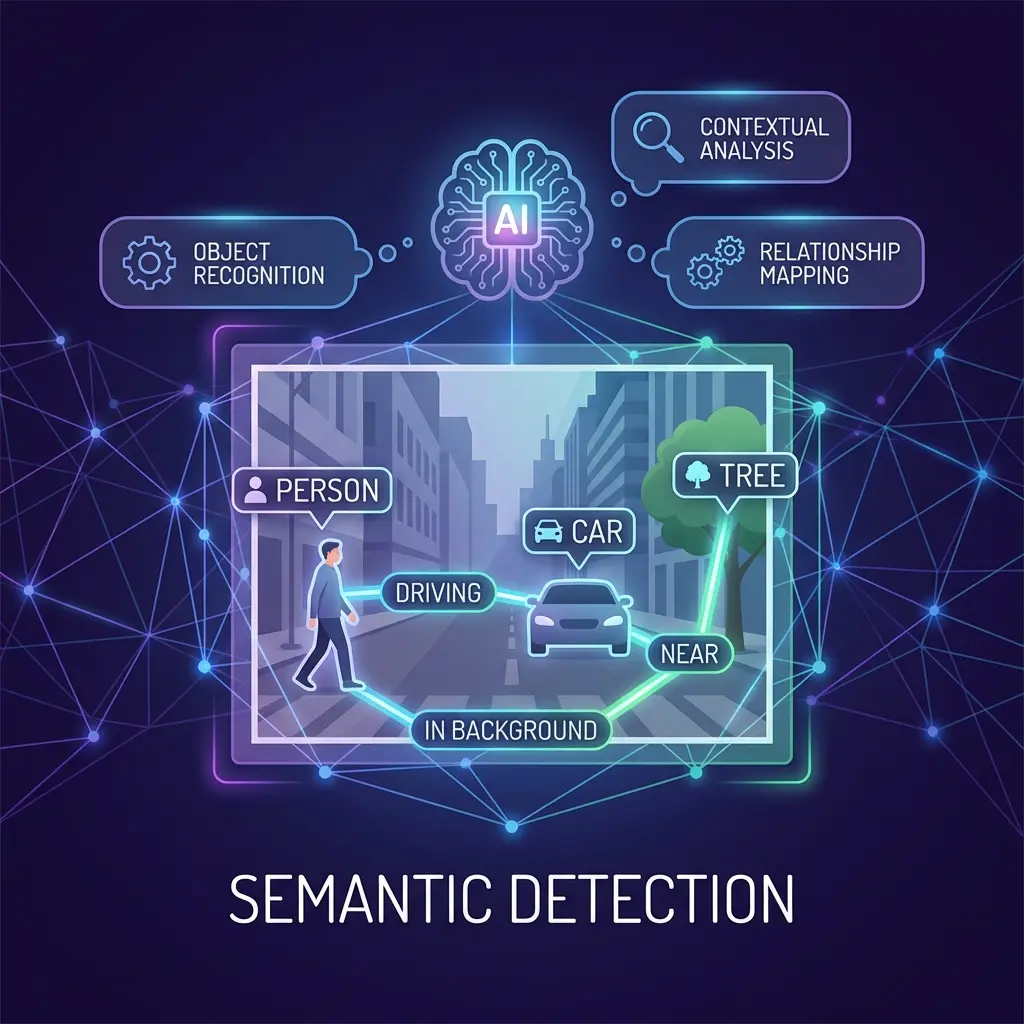
工作原理
AI models often generate images with logical inconsistencies that violate physical laws. This detector analyzes shadow directions, perspective geometry, reflection accuracy, and edge coherence to find these telltale errors.
Shadows
Check direction consistency
Perspective
Validate geometry
Reflections
Check mirror accuracy
Edges
Analyze coherence
Key Metrics
Shadow Consistency
Analyzes if all shadows point in the same direction based on light sources. AI often creates shadows that violate physical light propagation.
Perspective Validation
Checks if parallel lines converge correctly at vanishing points. AI frequently creates impossible geometric relationships.
Reflection Accuracy
Verifies that reflections in mirrors and water match their source objects. AI often generates incorrect or impossible reflections.
Edge Coherence
Analyzes edge patterns for continuity and natural transitions. AI edges often show abrupt changes or floating artifacts.
Frequently Asked Questions
What is semantic inconsistency in AI images?
Semantic inconsistency refers to logical errors in AI-generated images, such as shadows pointing in different directions, objects with impossible perspectives, or reflections that don't match their source. These errors occur because AI models don't understand physical laws.
How accurate is shadow detection?
Shadow direction analysis achieves 85-92% accuracy in detecting AI images. The method analyzes gradient directions across the image to determine if shadows consistently point away from light sources.
Can this detect Midjourney images?
Yes, Midjourney and other diffusion models frequently create semantic inconsistencies. While newer versions are improving, they still struggle with complex shadow interactions and perspective geometry in detailed scenes.
What types of perspective errors are detected?
The detector identifies vanishing point violations, parallel line inconsistencies, impossible object scaling, and depth plane mismatches. These errors are common in AI-generated architectural scenes and indoor photos.
Does image compression affect detection?
JPEG compression can reduce detection accuracy by 5-10%, but major semantic errors like incorrect shadow directions remain visible even in heavily compressed images. The detector is optimized to work with typical web image quality.
How does reflection analysis work?
The system detects reflective surfaces (mirrors, water, glass) and compares the reflected content with source objects. AI often creates reflections with wrong angles, missing elements, or objects that don't exist in the scene.
Why do AI images have shadow problems?
AI models learn from 2D images without understanding 3D light physics. They pattern-match shadows from training data but don't calculate actual light paths, leading to inconsistencies when generating novel scenes.
What is edge coherence analysis?
Edge coherence measures the consistency of object boundaries across the image. Real photos have natural edge transitions, while AI images often have floating edges, discontinuous boundaries, or artifacts where objects meet backgrounds.
How does this compare to ML detection?
Semantic analysis complements ML detection. While ML models detect statistical patterns, semantic analysis finds logical errors. This combination is more robust because it uses fundamentally different detection approaches.
Is this effective against future AI models?
Semantic errors are difficult for AI to eliminate without true 3D scene understanding. Even as AI improves, it will likely continue making subtle physical errors, making this method more future-proof than pattern-based detection alone.
相关方法
机器学习检测
我们的机器学习检测使用最先进的Transformer模型,在数百万张图像上训练,以区分真实照片和AI生成内容。
PRNU分析
光响应非均匀性(PRNU)检测来自制造缺陷的独特相机传感器指纹。AI图像无法复制这些真实的传感器签名。
频率分析
频域分析检查图像中高频和低频分量的分布。AI生成的图像通常缺乏真实照片中存在的自然高频噪声。
梯度分析
使用Sobel、Canny和Laplacian算子分析边缘模式和纹理特征。AI图像通常具有不自然平滑或均匀的梯度。
噪声模式
真实照片包含来自相机传感器的独特噪声模式,这些模式在图像中有所不同。AI生成的图像具有不自然的均匀噪声分布。
元数据分析
图像元数据包含关于其来源的重要线索。我们分析EXIF数据、软件签名和其他嵌入信息以识别AI生成工具。
GAN指纹
检测GAN特有的伪影,如棋盘格图案、色带和生成对抗网络特有的频谱异常。
纹理分析
局部二值模式分析用于检测AI生成图像中常见的纹理异常。测量均匀性、熵和同质性。
人体解剖检测
AI图像生成器经常创建人类立即识别为错误的解剖错误。我们使用计算机视觉来检测这些明显的错误。
C2PA验证
C2PA是通过加密签名跟踪数字内容来源和历史的行业标准。
Human Biometric Analysis
Uses MediaPipe to analyze human anatomy for incorrect finger counts, asymmetric eyes, unnatural skin texture, and other anatomical anomalies common in AI-generated faces.
Lighting Physics Validation
Validates light source consistency, shadow direction physics, specular highlight accuracy, and color temperature uniformity across the image.
Compression Artifact Analysis
Analyzes JPEG compression artifacts to estimate quality levels and detect re-compression patterns that indicate image manipulation or AI generation.
Edge Sharpness Analysis
Analyzes sharpness distribution across the image and validates depth-of-field consistency. AI often produces unnaturally uniform sharpness.
Statistical Pattern Analysis
Analyzes statistical properties including Shannon entropy, histogram patterns, and Benford's Law compliance to detect synthetic image characteristics.
Chromatic Aberration Analysis
Detects the absence of chromatic aberration (color fringing) that real camera lenses produce. AI images lack these optical artifacts.
Micro-Texture Analysis
Analyzes microscopic texture patterns for repetition, uniformity, and unnatural randomness that AI generators often exhibit.
Color Palette Analysis
Analyzes color distribution including saturation levels, color diversity, and white balance consistency. AI images often have oversaturated colors.