Chromatic Aberration Analysis
Missing Lens Artifacts
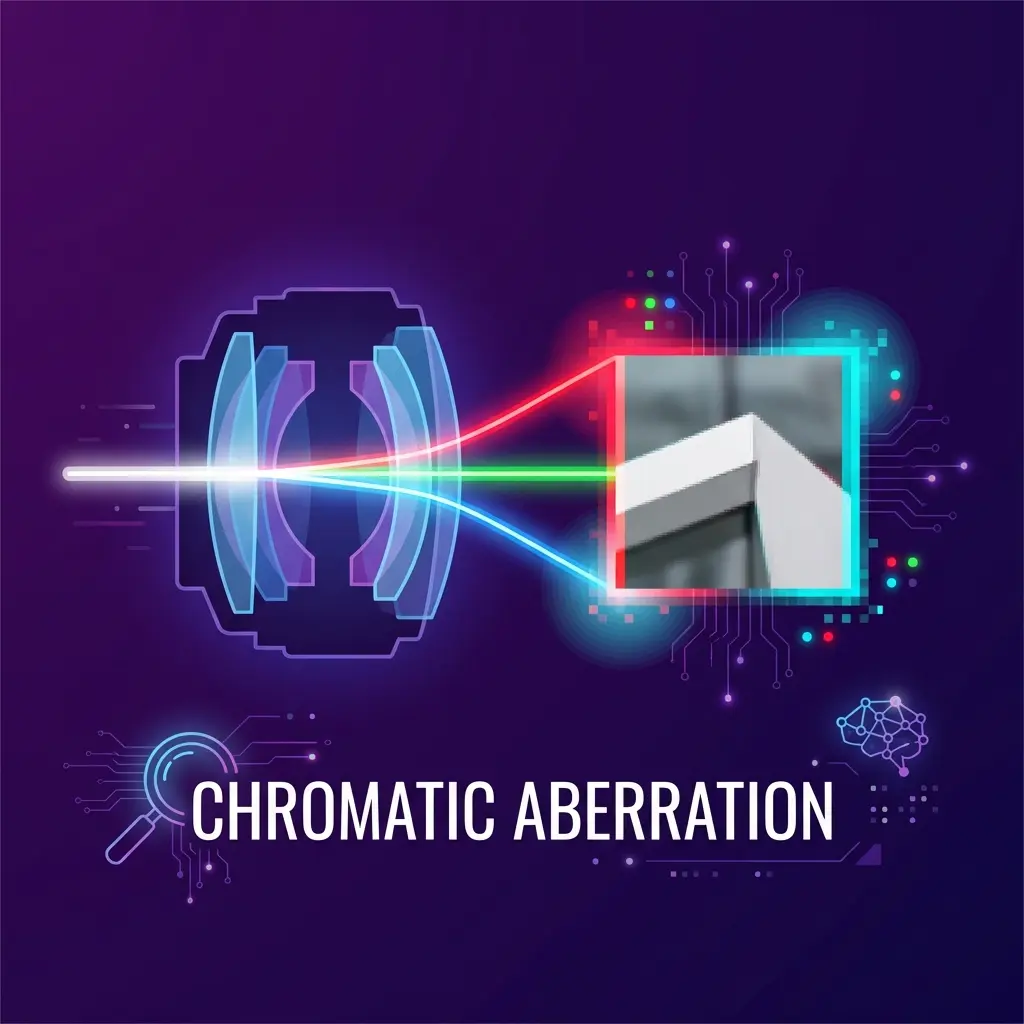
Detects the absence of chromatic aberration (color fringing) that real camera lenses produce. AI images lack these optical artifacts.
Frequently Asked Questions
What is chromatic aberration?
Chromatic aberration (CA) is color fringing at high-contrast edges caused by lenses bending different wavelengths of light at slightly different angles. It's visible as red/cyan or blue/yellow fringes.
Why don't AI images have CA?
AI generates images pixel by pixel without simulating optical physics. There's no virtual lens to create chromatic aberration, resulting in unnaturally clean edges.
Do modern cameras have CA?
Even expensive lenses have some CA. While in-camera software may reduce visible CA, traces remain in the raw data, especially at wide apertures or frame edges.
Can smartphone photos be detected?
Smartphones have small lenses with noticeable CA, especially at edges. However, computational photography often corrects this, reducing detection reliability.
How is CA measured?
By comparing red, green, and blue channel gradients at edges. Real CA shows consistent channel offsets; AI images have channels aligned perfectly at edges.
What about lens profile corrections?
Software corrections reduce visible CA but leave residual patterns. Complete CA removal is difficult, so traces usually remain for forensic analysis.
Is lateral and longitudinal CA detected?
Primarily lateral CA (color fringing increasing toward edges). Longitudinal CA (focus color shifts) is harder to detect but can provide additional signals.
Why is the weight only 3%?
CA correction is common in photo processing, and smartphone computational photography removes it. This makes CA absence less reliable as a standalone indicator.
Can AI add fake CA?
AI could theoretically add CA post-generation, but current models don't. Even if added, fake CA patterns would likely differ from authentic lens CA characteristics.
Does image resizing affect CA detection?
Downscaling reduces CA visibility but doesn't eliminate it. Very small images may have insufficient detail for reliable CA analysis.
相关方法
机器学习检测
我们的机器学习检测使用最先进的Transformer模型,在数百万张图像上训练,以区分真实照片和AI生成内容。
PRNU分析
光响应非均匀性(PRNU)检测来自制造缺陷的独特相机传感器指纹。AI图像无法复制这些真实的传感器签名。
频率分析
频域分析检查图像中高频和低频分量的分布。AI生成的图像通常缺乏真实照片中存在的自然高频噪声。
梯度分析
使用Sobel、Canny和Laplacian算子分析边缘模式和纹理特征。AI图像通常具有不自然平滑或均匀的梯度。
噪声模式
真实照片包含来自相机传感器的独特噪声模式,这些模式在图像中有所不同。AI生成的图像具有不自然的均匀噪声分布。
元数据分析
图像元数据包含关于其来源的重要线索。我们分析EXIF数据、软件签名和其他嵌入信息以识别AI生成工具。
GAN指纹
检测GAN特有的伪影,如棋盘格图案、色带和生成对抗网络特有的频谱异常。
纹理分析
局部二值模式分析用于检测AI生成图像中常见的纹理异常。测量均匀性、熵和同质性。
人体解剖检测
AI图像生成器经常创建人类立即识别为错误的解剖错误。我们使用计算机视觉来检测这些明显的错误。
C2PA验证
C2PA是通过加密签名跟踪数字内容来源和历史的行业标准。
Semantic Inconsistency Detection
Detects logical inconsistencies like incorrect shadows, impossible perspectives, distorted reflections, and violations of physical laws that AI often produces.
Human Biometric Analysis
Uses MediaPipe to analyze human anatomy for incorrect finger counts, asymmetric eyes, unnatural skin texture, and other anatomical anomalies common in AI-generated faces.
Lighting Physics Validation
Validates light source consistency, shadow direction physics, specular highlight accuracy, and color temperature uniformity across the image.
Compression Artifact Analysis
Analyzes JPEG compression artifacts to estimate quality levels and detect re-compression patterns that indicate image manipulation or AI generation.
Edge Sharpness Analysis
Analyzes sharpness distribution across the image and validates depth-of-field consistency. AI often produces unnaturally uniform sharpness.
Statistical Pattern Analysis
Analyzes statistical properties including Shannon entropy, histogram patterns, and Benford's Law compliance to detect synthetic image characteristics.
Micro-Texture Analysis
Analyzes microscopic texture patterns for repetition, uniformity, and unnatural randomness that AI generators often exhibit.
Color Palette Analysis
Analyzes color distribution including saturation levels, color diversity, and white balance consistency. AI images often have oversaturated colors.