Semantic Inconsistency Detection
Logic & Physics Validation
Detects logical inconsistencies like incorrect shadows, impossible perspectives, distorted reflections, and violations of physical laws that AI often produces.
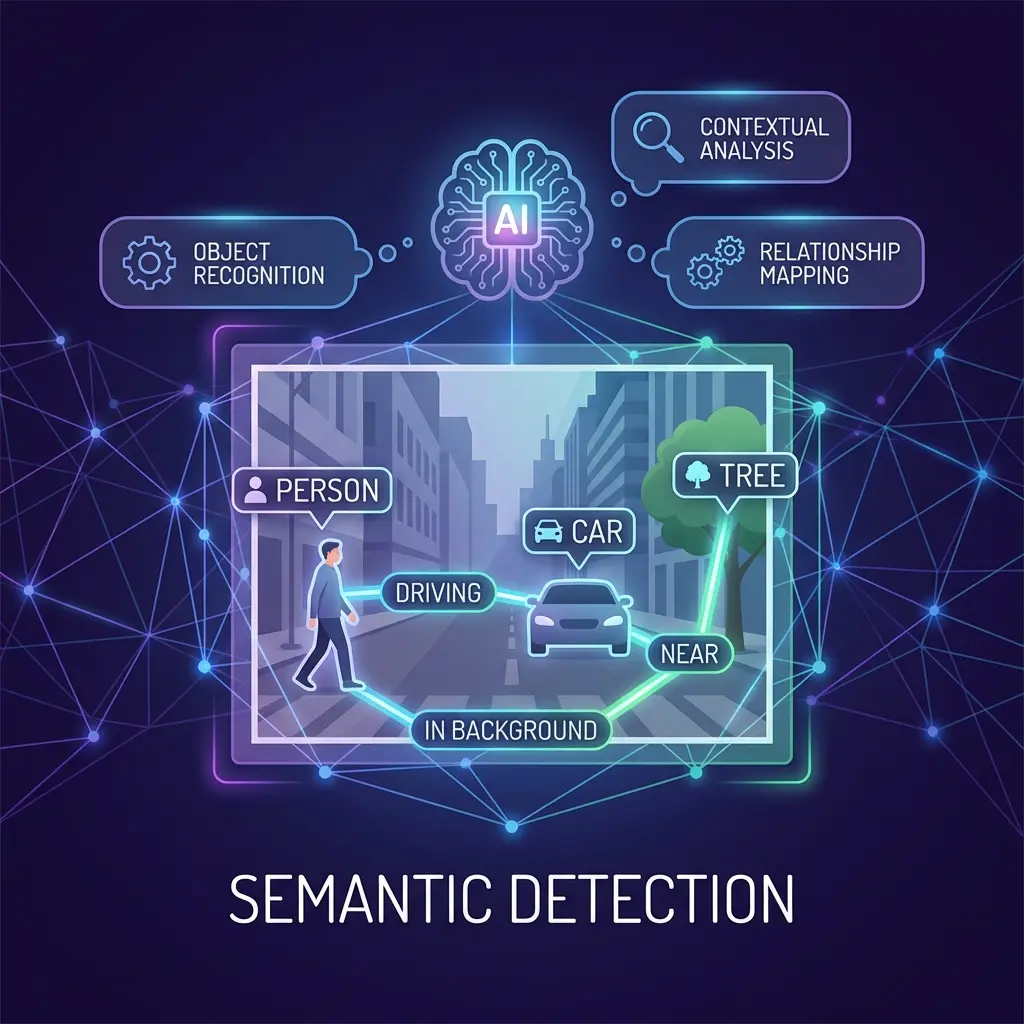
Cómo funciona
AI models often generate images with logical inconsistencies that violate physical laws. This detector analyzes shadow directions, perspective geometry, reflection accuracy, and edge coherence to find these telltale errors.
Shadows
Check direction consistency
Perspective
Validate geometry
Reflections
Check mirror accuracy
Edges
Analyze coherence
Key Metrics
Shadow Consistency
Analyzes if all shadows point in the same direction based on light sources. AI often creates shadows that violate physical light propagation.
Perspective Validation
Checks if parallel lines converge correctly at vanishing points. AI frequently creates impossible geometric relationships.
Reflection Accuracy
Verifies that reflections in mirrors and water match their source objects. AI often generates incorrect or impossible reflections.
Edge Coherence
Analyzes edge patterns for continuity and natural transitions. AI edges often show abrupt changes or floating artifacts.
Frequently Asked Questions
What is semantic inconsistency in AI images?
Semantic inconsistency refers to logical errors in AI-generated images, such as shadows pointing in different directions, objects with impossible perspectives, or reflections that don't match their source. These errors occur because AI models don't understand physical laws.
How accurate is shadow detection?
Shadow direction analysis achieves 85-92% accuracy in detecting AI images. The method analyzes gradient directions across the image to determine if shadows consistently point away from light sources.
Can this detect Midjourney images?
Yes, Midjourney and other diffusion models frequently create semantic inconsistencies. While newer versions are improving, they still struggle with complex shadow interactions and perspective geometry in detailed scenes.
What types of perspective errors are detected?
The detector identifies vanishing point violations, parallel line inconsistencies, impossible object scaling, and depth plane mismatches. These errors are common in AI-generated architectural scenes and indoor photos.
Does image compression affect detection?
JPEG compression can reduce detection accuracy by 5-10%, but major semantic errors like incorrect shadow directions remain visible even in heavily compressed images. The detector is optimized to work with typical web image quality.
How does reflection analysis work?
The system detects reflective surfaces (mirrors, water, glass) and compares the reflected content with source objects. AI often creates reflections with wrong angles, missing elements, or objects that don't exist in the scene.
Why do AI images have shadow problems?
AI models learn from 2D images without understanding 3D light physics. They pattern-match shadows from training data but don't calculate actual light paths, leading to inconsistencies when generating novel scenes.
What is edge coherence analysis?
Edge coherence measures the consistency of object boundaries across the image. Real photos have natural edge transitions, while AI images often have floating edges, discontinuous boundaries, or artifacts where objects meet backgrounds.
How does this compare to ML detection?
Semantic analysis complements ML detection. While ML models detect statistical patterns, semantic analysis finds logical errors. This combination is more robust because it uses fundamentally different detection approaches.
Is this effective against future AI models?
Semantic errors are difficult for AI to eliminate without true 3D scene understanding. Even as AI improves, it will likely continue making subtle physical errors, making this method more future-proof than pattern-based detection alone.
Métodos relacionados
Detección ML
Nuestra detección ML usa modelos Transformer entrenados en millones de imágenes.
Análisis PRNU
Photo Response Non-Uniformity (PRNU) detects unique camera sensor fingerprints from manufacturing imperfections. AI images cannot replicate these authentic sensor signatures.
Análisis de Frecuencia
El análisis del dominio de frecuencia examina la distribución de componentes de alta y baja frecuencia en una imagen. Las imágenes generadas por IA típicamente carecen del ruido natural de alta frecuencia presente en fotografías reales.
Análisis de gradiente
Analyzes edge patterns and texture characteristics using Sobel, Canny, and Laplacian operators. AI images often have unnaturally smooth or uniform gradients.
Patrón de ruido
Las fotografías reales contienen patrones de ruido únicos de los sensores de cámara que varían a través de la imagen. Las imágenes generadas por IA tienen una distribución de ruido anormalmente uniforme.
Análisis de metadatos
Los metadatos de imagen contienen pistas valiosas sobre su origen. Analizamos datos EXIF, firmas de software y otra información incrustada para identificar herramientas de generación de IA.
Huella GAN
Detecta artefactos específicos de GAN como patrones de tablero de ajedrez y bandas de color.
Análisis de textura
Análisis Local Binary Pattern para anomalías de textura en imágenes IA.
Detección Anatómica
Los generadores de imágenes de IA a menudo crean errores anatómicos que los humanos reconocen inmediatamente como incorrectos. Usamos visión por computadora para detectar estos errores reveladores.
Verificación C2PA
C2PA (Coalition for Content Provenance and Authenticity) es un estándar de la industria para rastrear el origen y la historia del contenido digital a través de firmas criptográficas.
Human Biometric Analysis
Uses MediaPipe to analyze human anatomy for incorrect finger counts, asymmetric eyes, unnatural skin texture, and other anatomical anomalies common in AI-generated faces.
Lighting Physics Validation
Validates light source consistency, shadow direction physics, specular highlight accuracy, and color temperature uniformity across the image.
Compression Artifact Analysis
Analyzes JPEG compression artifacts to estimate quality levels and detect re-compression patterns that indicate image manipulation or AI generation.
Edge Sharpness Analysis
Analyzes sharpness distribution across the image and validates depth-of-field consistency. AI often produces unnaturally uniform sharpness.
Statistical Pattern Analysis
Analyzes statistical properties including Shannon entropy, histogram patterns, and Benford's Law compliance to detect synthetic image characteristics.
Chromatic Aberration Analysis
Detects the absence of chromatic aberration (color fringing) that real camera lenses produce. AI images lack these optical artifacts.
Micro-Texture Analysis
Analyzes microscopic texture patterns for repetition, uniformity, and unnatural randomness that AI generators often exhibit.
Color Palette Analysis
Analyzes color distribution including saturation levels, color diversity, and white balance consistency. AI images often have oversaturated colors.
Verificar Tu Imagen
Todos los métodos se combinan usando puntuación ponderada para producir un veredicto final con nivel de confianza.
Probar Ahora