Texture Analysis
LBP-Mustererkennung
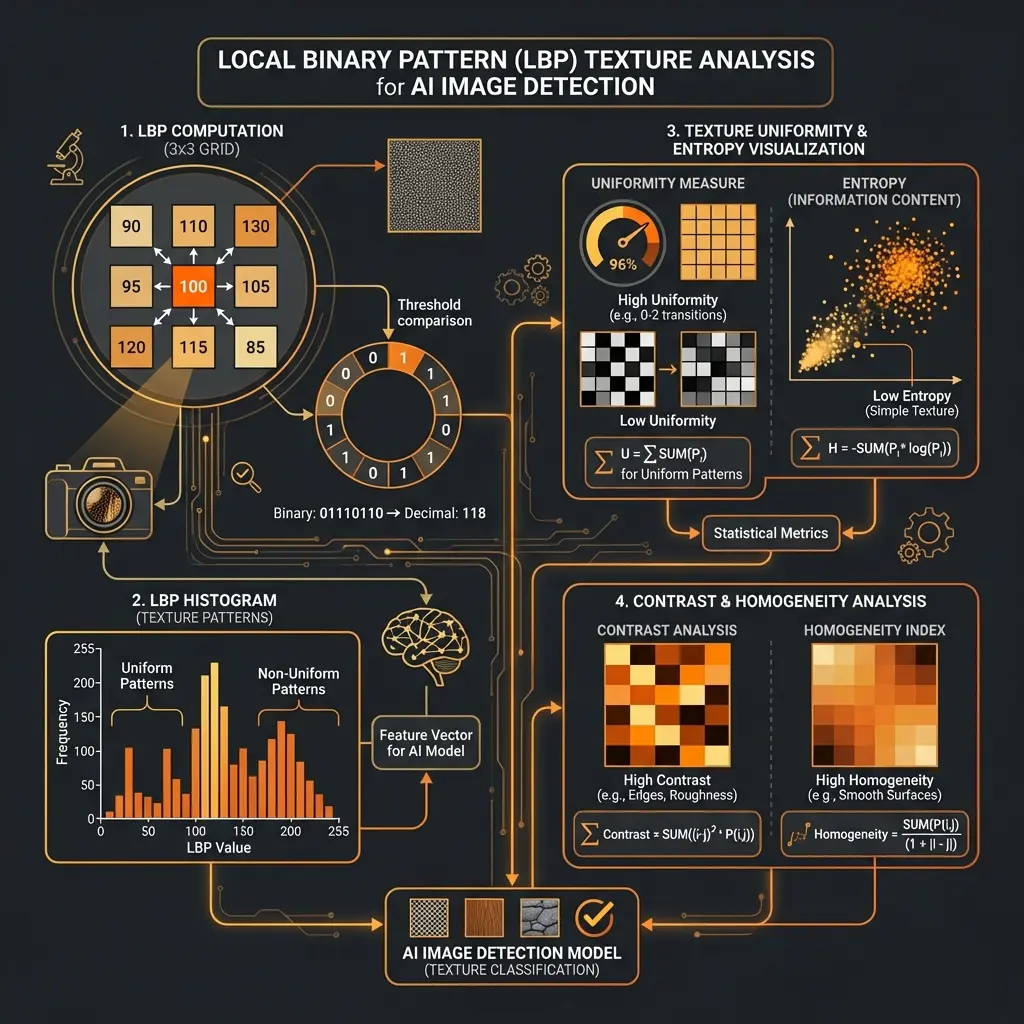
Local Binary Patterns (LBP) is a powerful texture descriptor that captures micro-patterns in images. AI-generated images often have different texture characteristics compared to real photographs.
Local Binary Patterns (LBP)
How LBP Works
LBP compares each pixel with its surrounding neighbors. If a neighbor is greater than or equal to the center pixel, it gets a 1; otherwise, it gets a 0. The resulting binary pattern encodes local texture information.
This creates a histogram of texture patterns that is rotation-invariant and robust to illumination changes.
  5   6   8
  4  [6]  9    → Binary: 01110001 → Decimal: 113
  2   7   3
Example: Center pixel = 6, neighbors compared clockwise
Texture Metrics
LBP Uniformity
Measures how uniform the LBP histogram is. AI images often show abnormally high uniformity due to synthetic texture generation.
LBP Entropy
Calculates the information entropy of the LBP histogram. Lower entropy indicates less texture variety, common in AI-generated content.
Texture Contrast
Measures local contrast in the texture. AI images tend to have different contrast patterns compared to real photos captured by cameras.
Texture Homogeneity
Evaluates the smoothness of texture transitions. AI generators often produce unnaturally smooth or overly uniform texture areas.
Technical Details
LBP Parameters
- • Radius: 1 pixel (default)
- • Neighbors: 8 sampling points
- • Histogram bins: 256
- • Gray-level co-occurrence matrix (GLCM)
AI Indicators
- High LBP uniformity (> 0.35)
- Low entropy (< 4.5)
- Abnormal contrast distribution
- Excessive homogeneity (> 0.8)
Verwandte Methoden
ML-Erkennung
Unsere ML-Erkennung nutzt modernste Transformer-Modelle, die auf Millionen von Bildern trainiert wurden.
PRNU-Analyse
Photo Response Non-Uniformity (PRNU) detects unique camera sensor fingerprints from manufacturing imperfections. AI images cannot replicate these authentic sensor signatures.
Frequenzanalyse
Die Frequenzdomänenanalyse untersucht die Verteilung von Hoch- und Niederfrequenzkomponenten in einem Bild. KI-generierte Bilder fehlt typischerweise das natürliche Hochfrequenzrauschen echter Fotografien.
Gradientenanalyse
Analyzes edge patterns and texture characteristics using Sobel, Canny, and Laplacian operators. AI images often have unnaturally smooth or uniform gradients.
Rauschmuster
Echte Fotografien enthalten einzigartige Rauschmuster von Kamerasensoren, die über das Bild variieren. KI-generierte Bilder haben eine unnatürlich gleichmäßige Rauschverteilung.
Metadatenanalyse
Bildmetadaten enthalten wertvolle Hinweise auf den Ursprung. Wir analysieren EXIF-Daten, Softwaresignaturen und andere eingebettete Informationen, um KI-Generierungswerkzeuge zu identifizieren.
GAN-Fingerabdruck
Erkennt GAN-spezifische Artefakte wie Schachbrettmuster, Farbbanding und spektrale Anomalien.
Anatomische Erkennung
KI-Bildgeneratoren erzeugen oft anatomische Fehler, die Menschen sofort als falsch erkennen. Wir nutzen Computer Vision, um diese verräterischen Fehler zu erkennen.
C2PA-Verifizierung
C2PA (Coalition for Content Provenance and Authenticity) ist ein Industriestandard zur Verfolgung von Ursprung und Geschichte digitaler Inhalte durch kryptografische Signaturen.
Semantic Inconsistency Detection
Detects logical inconsistencies like incorrect shadows, impossible perspectives, distorted reflections, and violations of physical laws that AI often produces.
Human Biometric Analysis
Uses MediaPipe to analyze human anatomy for incorrect finger counts, asymmetric eyes, unnatural skin texture, and other anatomical anomalies common in AI-generated faces.
Lighting Physics Validation
Validates light source consistency, shadow direction physics, specular highlight accuracy, and color temperature uniformity across the image.
Compression Artifact Analysis
Analyzes JPEG compression artifacts to estimate quality levels and detect re-compression patterns that indicate image manipulation or AI generation.
Edge Sharpness Analysis
Analyzes sharpness distribution across the image and validates depth-of-field consistency. AI often produces unnaturally uniform sharpness.
Statistical Pattern Analysis
Analyzes statistical properties including Shannon entropy, histogram patterns, and Benford's Law compliance to detect synthetic image characteristics.
Chromatic Aberration Analysis
Detects the absence of chromatic aberration (color fringing) that real camera lenses produce. AI images lack these optical artifacts.
Micro-Texture Analysis
Analyzes microscopic texture patterns for repetition, uniformity, and unnatural randomness that AI generators often exhibit.
Color Palette Analysis
Analyzes color distribution including saturation levels, color diversity, and white balance consistency. AI images often have oversaturated colors.
Ihr Bild Prüfen
Alle Methoden werden mit gewichteter Bewertung kombiniert, um ein endgültiges Urteil mit Konfidenzniveau zu erzeugen.
Jetzt Ausprobieren