Edge Sharpness Analysis
Depth-of-Field Consistency
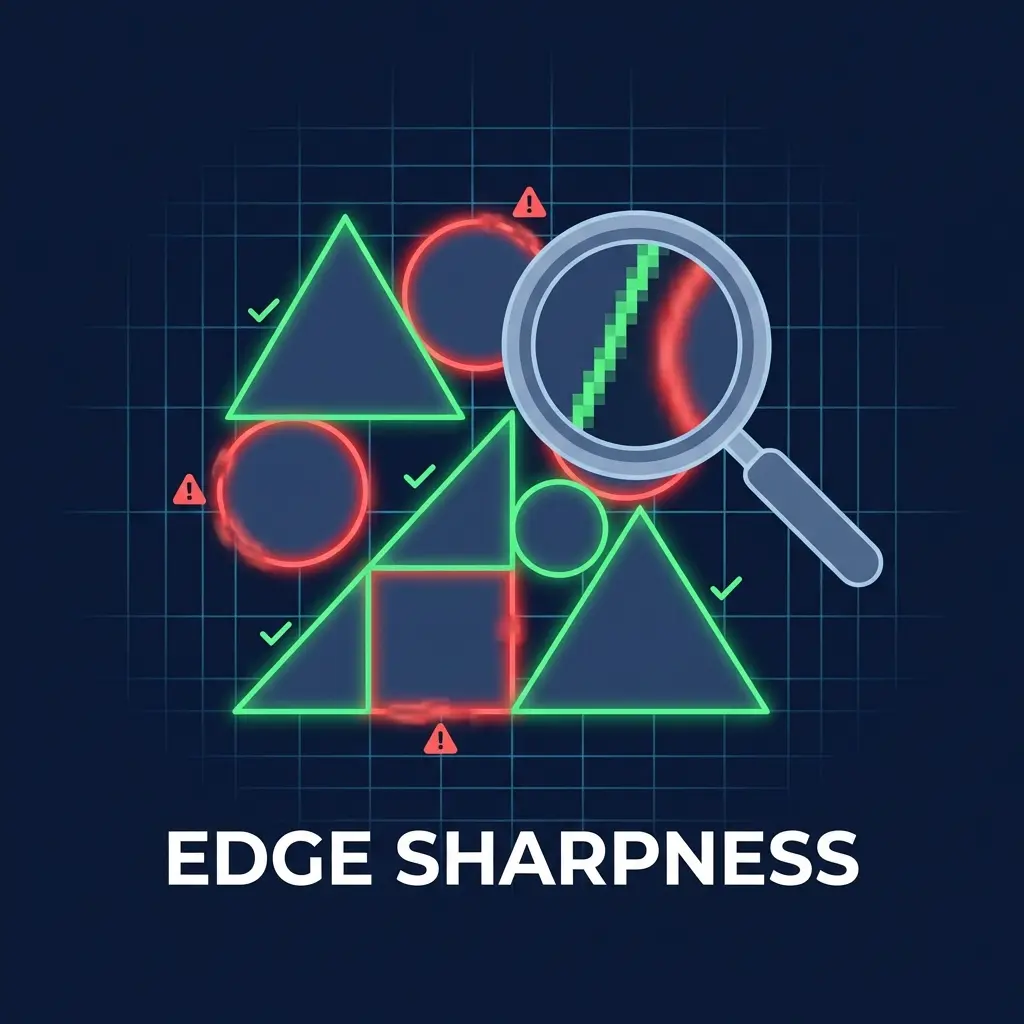
Analyzes sharpness distribution across the image and validates depth-of-field consistency. AI often produces unnaturally uniform sharpness.
Frequently Asked Questions
What is edge sharpness distribution?
Real photos have varying sharpness based on focus distance - objects at the focal plane are sharp while others are blurred. AI often produces uniformly sharp images throughout.
How is depth-of-field analyzed?
The detector measures sharpness at different estimated depths. Real DoF follows optical laws with smooth blur transitions; AI blur often has abrupt changes.
Why do AI images have uniform sharpness?
AI models don't simulate lens optics. They generate all details equally unless specifically prompted for bokeh, resulting in flat sharpness profiles.
Can AI-generated bokeh be detected?
Yes, AI-generated blur patterns often have unrealistic characteristics like uniform blur circles, incorrect bokeh shapes, or blur that doesn't correlate with depth.
What about photos with f/16 aperture?
Deep depth-of-field photos still have subtle sharpness variations and proper lens characteristics like diffraction softening. AI doesn't replicate these optical properties.
How does this detect upscaled images?
AI upscaling often adds sharpness uniformly. This creates unnaturally consistent edge profiles that differ from optically captured detail.
What is the sharpness coefficient of variation?
This measures how much sharpness varies across the image. Real photos have high variation (0.3-0.8); AI images often have low variation (0.1-0.3).
Are motion blur and DoF blur different?
Yes, motion blur is directional while DoF blur is uniform. AI often confuses these, creating motion-style blur when DoF is intended.
Does sharpening affect detection?
Post-processing sharpening can affect results, but it creates distinctive halo artifacts that the detector also identifies as non-natural patterns.
Why is this weighted at 6%?
Sharpness analysis provides useful signals but can be affected by post-processing and display scaling. It complements other methods rather than serving as a primary detector.
Verwandte Methoden
ML-Erkennung
Unsere ML-Erkennung nutzt modernste Transformer-Modelle, die auf Millionen von Bildern trainiert wurden.
PRNU-Analyse
Photo Response Non-Uniformity (PRNU) detects unique camera sensor fingerprints from manufacturing imperfections. AI images cannot replicate these authentic sensor signatures.
Frequenzanalyse
Die Frequenzdomänenanalyse untersucht die Verteilung von Hoch- und Niederfrequenzkomponenten in einem Bild. KI-generierte Bilder fehlt typischerweise das natürliche Hochfrequenzrauschen echter Fotografien.
Gradientenanalyse
Analyzes edge patterns and texture characteristics using Sobel, Canny, and Laplacian operators. AI images often have unnaturally smooth or uniform gradients.
Rauschmuster
Echte Fotografien enthalten einzigartige Rauschmuster von Kamerasensoren, die über das Bild variieren. KI-generierte Bilder haben eine unnatürlich gleichmäßige Rauschverteilung.
Metadatenanalyse
Bildmetadaten enthalten wertvolle Hinweise auf den Ursprung. Wir analysieren EXIF-Daten, Softwaresignaturen und andere eingebettete Informationen, um KI-Generierungswerkzeuge zu identifizieren.
GAN-Fingerabdruck
Erkennt GAN-spezifische Artefakte wie Schachbrettmuster, Farbbanding und spektrale Anomalien.
Texturanalyse
Local Binary Pattern Analyse für Texturanomalien in KI-generierten Bildern.
Anatomische Erkennung
KI-Bildgeneratoren erzeugen oft anatomische Fehler, die Menschen sofort als falsch erkennen. Wir nutzen Computer Vision, um diese verräterischen Fehler zu erkennen.
C2PA-Verifizierung
C2PA (Coalition for Content Provenance and Authenticity) ist ein Industriestandard zur Verfolgung von Ursprung und Geschichte digitaler Inhalte durch kryptografische Signaturen.
Semantic Inconsistency Detection
Detects logical inconsistencies like incorrect shadows, impossible perspectives, distorted reflections, and violations of physical laws that AI often produces.
Human Biometric Analysis
Uses MediaPipe to analyze human anatomy for incorrect finger counts, asymmetric eyes, unnatural skin texture, and other anatomical anomalies common in AI-generated faces.
Lighting Physics Validation
Validates light source consistency, shadow direction physics, specular highlight accuracy, and color temperature uniformity across the image.
Compression Artifact Analysis
Analyzes JPEG compression artifacts to estimate quality levels and detect re-compression patterns that indicate image manipulation or AI generation.
Statistical Pattern Analysis
Analyzes statistical properties including Shannon entropy, histogram patterns, and Benford's Law compliance to detect synthetic image characteristics.
Chromatic Aberration Analysis
Detects the absence of chromatic aberration (color fringing) that real camera lenses produce. AI images lack these optical artifacts.
Micro-Texture Analysis
Analyzes microscopic texture patterns for repetition, uniformity, and unnatural randomness that AI generators often exhibit.
Color Palette Analysis
Analyzes color distribution including saturation levels, color diversity, and white balance consistency. AI images often have oversaturated colors.
Ihr Bild Prüfen
Alle Methoden werden mit gewichteter Bewertung kombiniert, um ein endgültiges Urteil mit Konfidenzniveau zu erzeugen.
Jetzt Ausprobieren