AI Image Detector V3: 3-Stage Cascade Detection Explained (C2PA, SynthID & Neural AI)
Introducing AI Image Detector V3 — The Cascade Era
Detecting AI-generated images in 2026 is a completely different problem than it was even two years ago. Generators like Flux, Midjourney v7, DALL-E 3, and Google Imagen produce photorealistic images that fool both humans and older detection models. At the same time, the industry has quietly built something powerful: cryptographic provenance standards that make many AI images provably AI — no guessing required.
AI Image Detector V3 is our answer to both trends. Instead of running one detection method and hoping for the best, V3 runs a 3-stage cascade that evaluates the strongest evidence first and escalates only when needed. It is now the default detector on AI Photo Check.
Try AI Image Detector V3 free →
How the 3-Stage Cascade Works
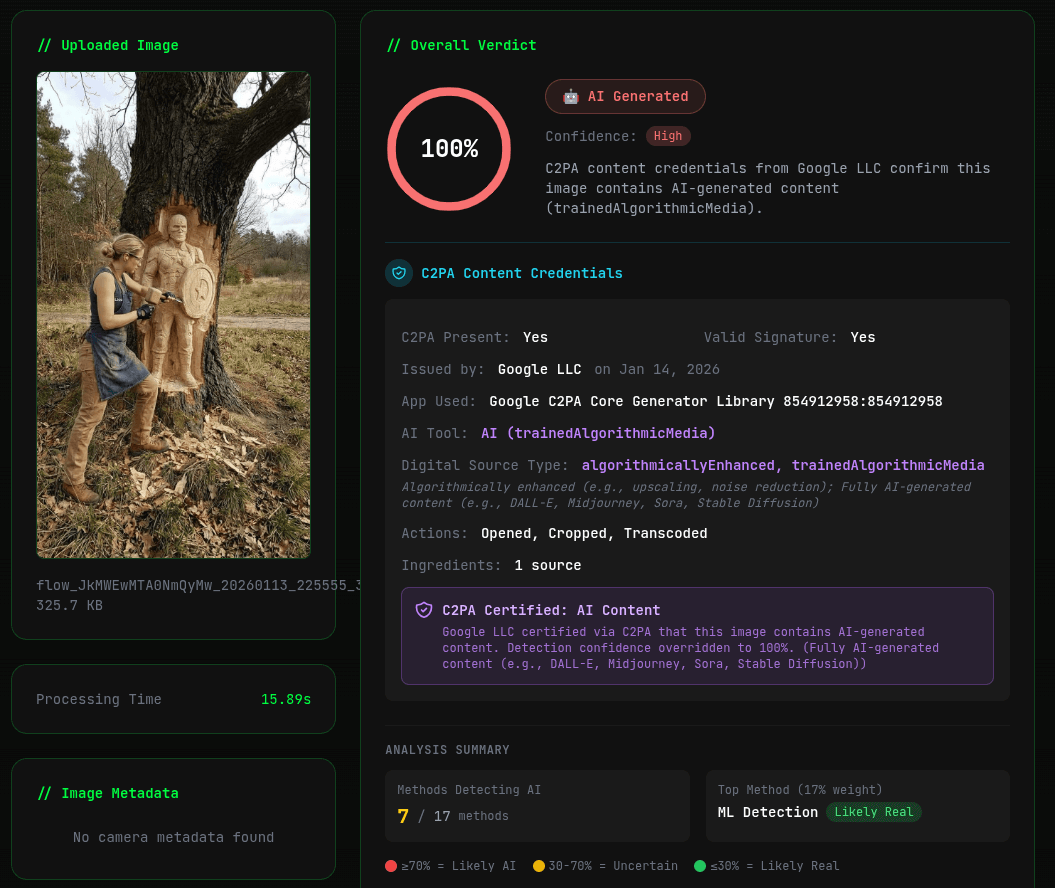
🔏 Stage 1 — Cryptographic Provenance (under 1 second)
Before analyzing a single pixel, V3 checks whether the image carries proof of its own origin:
- C2PA Content Credentials — the industry standard for signed provenance metadata. In 2026, images from DALL-E, Gemini, Adobe Firefly, and even modern cameras (Sony, Leica, Samsung) ship with cryptographically signed C2PA manifests that record exactly which tool created the image.
- Google SynthID watermarks — invisible watermarks embedded in images from Google's AI models. Since OpenAI adopted SynthID in May 2026, this single check now covers content from the two largest AI image producers in the world.
- Embedded generator markers — binary signatures left by Midjourney, DALL-E, Stable Diffusion, and other tools inside the file structure.
When Stage 1 finds hard evidence, the verdict is instant and near-certain — no statistical model can match a cryptographic signature. Importantly, a C2PA manifest from a real camera is treated as evidence of authenticity context, never misread as an AI marker.
🧠 Stage 2 — Modern Neural Classifier (2-6 seconds)
Most images on the internet have had their metadata stripped by social media platforms, so Stage 2 does the heavy lifting for everyday detection. V3 uses an advanced neural vision model, continuously updated and trained on output from today's leading generators — Flux, Midjourney, DALL-E, and the Stable Diffusion family.
This matters because older detectors (including many free tools online) were trained on GAN-era or early-diffusion images and simply cannot recognize what modern generators produce. When the classifier is confident, the verdict is finalized right here — typically within a few seconds.
🔍 Stage 3 — LLM Deep Analysis (only when needed)
Some images are genuinely hard: heavily retouched photos, AI images that were re-compressed by social media, screenshots, low-resolution files. For these ambiguous cases, V3 escalates to a Large Language Model visual analysis that examines faces, hands, hair, lighting physics, textures, and fine details — then writes a detailed expert-style report in your choice of 30+ languages, explaining exactly why the image looks AI-generated or authentic.
Because Stage 3 only runs for ambiguous images, V3 delivers deep analysis where it matters without slowing down every check.
V1 vs V2 vs V3 — What Changed?
| Feature | V1 (17 Methods) | V2 (LLM) | V3 (Cascade) |
|---|---|---|---|
| Typical speed | 30-60s | 10-40s | 1-6s |
| C2PA / SynthID provenance | — | Detected, advisory | Decisive evidence |
| Trained on current-generation AI images | No | Partially | Yes |
| Written expert report | — | Always | When it matters |
| Explains its verdict | Method scores | Full report | Evidence + report |
V1 and V2 remain available: V1 Classic (17-method forensics) for method-by-method scores, and V2 (LLM) for a full written report on every image.
Why a Cascade Beats a Single Detector
Every detection approach has blind spots. Classifiers struggle with novel content types. LLMs can be fooled by high-quality photorealism. Metadata can be stripped. The cascade design means each image is judged by the strongest available evidence:
- If cryptographic proof exists → use it (near-100% certainty)
- If the neural classifier is confident → trust the statistics
- If neither is conclusive → bring in expert-level visual reasoning
The result: faster verdicts for easy cases, deeper analysis for hard ones, and a clear explanation of which evidence decided every verdict.
Who Is V3 For?
📰 Journalists & Fact-Checkers
Verify user-submitted images in seconds. When C2PA or SynthID evidence exists, you get provenance-grade proof you can cite. When it doesn't, the classifier + LLM report gives you specific visual findings.
🛒 Marketplaces & Content Platforms
Screen product photos and user uploads at speed — most checks finish in under 6 seconds, fast enough for review workflows.
⚖️ Legal, Insurance & HR
Authenticate photographic evidence with a layered report: provenance findings, classifier probability, and (for ambiguous images) a detailed written analysis.
👤 Everyone Else
Saw a suspicious photo on social media? Upload it and get a clear verdict — free, no account required.
Frequently Asked Questions
Is AI Image Detector V3 free?
Yes. Every visitor gets free checks with no account. Heavy users can subscribe to the Unlimited plan ($5/month) — payable by PayPal or card (Stripe) — for unlimited checks and priority processing.
Can V3 detect images from Flux and Midjourney v7?
Yes. Stage 2 uses a classifier trained on modern generator output, and Stage 1 catches provenance markers that many 2026 generators now embed. No detector is perfect — heavily post-processed AI images remain the hardest case, which is exactly what Stage 3's LLM analysis is for.
What is C2PA and why does it matter?
C2PA (Coalition for Content Provenance and Authenticity) is a cryptographic standard that records an image's origin and edit history in signed metadata. When present and valid, it is stronger evidence than any statistical detector. You can also inspect C2PA data directly with our free C2PA Checker tool.
What is SynthID?
SynthID is Google DeepMind's invisible watermarking technology, embedded in images from Google's AI models — and since May 2026, OpenAI's models too. V3 scans for SynthID markers as part of Stage 1.
Try V3 Now
Upload any image and watch the cascade work in real time — you'll see exactly which stage decided the verdict and why.
Ready to verify your images?
Try our free AI image detector with 17 detection methods and 90%+ accuracy.
Try AI Photo Check Free