Micro-Texture Analysis
Texture Repetition Detection
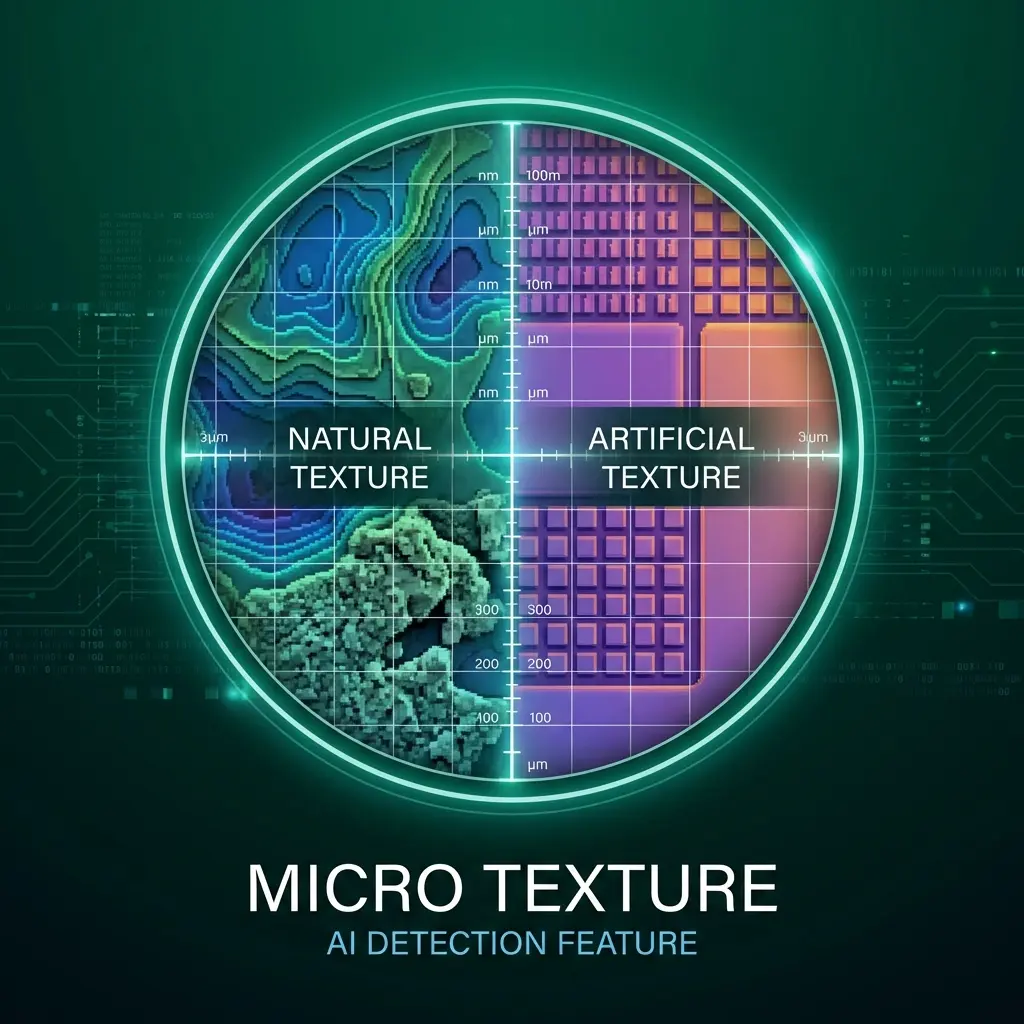
Analyzes microscopic texture patterns for repetition, uniformity, and unnatural randomness that AI generators often exhibit.
Frequently Asked Questions
What is micro-texture analysis?
Examination of fine-grained texture patterns at small scales (patches of 32x32 pixels or smaller) to detect repetition, uniformity, or unnatural statistical properties.
How does AI create texture repetition?
AI models use pattern-matching from training data. When generating textures, they may repeat learned patterns, especially in areas like grass, fabric, or skin.
What is autocorrelation used for?
Autocorrelation measures self-similarity at different offsets. High secondary peaks indicate repeating patterns - a common AI artifact in texture generation.
What is natural randomness?
Real textures have specific statistical distributions (skewness, kurtosis). AI textures often appear too Gaussian or overly symmetric - unnaturally "perfect" randomness.
Can this detect skin texture?
Yes, AI skin often lacks natural pore variation or has unusually uniform texture. The detector analyzes local variance consistency to identify these artifacts.
What about fabric and material textures?
AI-generated fabrics often show subtle tiling or periodic patterns. Real fabrics have manufacturing irregularities that create non-repeating variations.
How is uniformity measured?
By computing local variance in small patches across the image. Real photos have varying texture intensity; AI often has suspiciously consistent texture quality everywhere.
Does this work on smooth surfaces?
Smooth surfaces have less texture to analyze, reducing detection reliability. Other methods like lighting and edge analysis become more important for smooth subjects.
What is the Perlin noise problem?
Some AI uses Perlin noise for variations, which has distinctive mathematical properties. The detector identifies these synthetic noise characteristics.
Why is weight 3% for this method?
Micro-texture analysis is subtle and can be affected by compression and resizing. It provides supporting evidence rather than definitive detection.
Powiązane metody
ML Detection
Our machine learning detection uses state-of-the-art transformer models trained on millions of images to distinguish between authentic photographs and AI-generated content.
PRNU Analysis
Photo Response Non-Uniformity (PRNU) detects unique camera sensor fingerprints from manufacturing imperfections. AI images cannot replicate these authentic sensor signatures.
Analiza częstotliwości
Frequency domain analysis examines the distribution of high and low frequency components in an image. AI-generated images typically lack the natural high-frequency noise present in real photographs.
Gradient Analysis
Analyzes edge patterns and texture characteristics using Sobel, Canny, and Laplacian operators. AI images often have unnaturally smooth or uniform gradients.
Noise Pattern
Real photographs contain unique noise patterns from camera sensors that vary across the image. AI-generated images have unnaturally uniform noise distribution.
Metadata Analysis
Image metadata contains valuable clues about its origin. We analyze EXIF data, software signatures, and other embedded information to identify AI generation tools.
GAN Fingerprint
Detects GAN-specific artifacts like checkerboard patterns, color banding, and spectral anomalies unique to generative adversarial networks.
Texture Analysis
Local Binary Pattern analysis for texture anomalies common in AI-generated images. Measures uniformity, entropy, and homogeneity.
Anatomy Detection
AI image generators often create anatomical errors that humans immediately recognize as wrong. We use computer vision to detect these telltale mistakes.
C2PA Verification
C2PA (Coalition for Content Provenance and Authenticity) is an industry standard for tracking the origin and history of digital content through cryptographic signatures.
Semantic Inconsistency Detection
Detects logical inconsistencies like incorrect shadows, impossible perspectives, distorted reflections, and violations of physical laws that AI often produces.
Human Biometric Analysis
Uses MediaPipe to analyze human anatomy for incorrect finger counts, asymmetric eyes, unnatural skin texture, and other anatomical anomalies common in AI-generated faces.
Lighting Physics Validation
Validates light source consistency, shadow direction physics, specular highlight accuracy, and color temperature uniformity across the image.
Compression Artifact Analysis
Analyzes JPEG compression artifacts to estimate quality levels and detect re-compression patterns that indicate image manipulation or AI generation.
Edge Sharpness Analysis
Analyzes sharpness distribution across the image and validates depth-of-field consistency. AI often produces unnaturally uniform sharpness.
Statistical Pattern Analysis
Analyzes statistical properties including Shannon entropy, histogram patterns, and Benford's Law compliance to detect synthetic image characteristics.
Chromatic Aberration Analysis
Detects the absence of chromatic aberration (color fringing) that real camera lenses produce. AI images lack these optical artifacts.
Color Palette Analysis
Analyzes color distribution including saturation levels, color diversity, and white balance consistency. AI images often have oversaturated colors.
Sprawdź obraz
All methods are combined using weighted scoring to produce a final verdict with confidence level.
Wypróbuj teraz