Texture Analysis
LBPパターン検出
Local Binary Patterns (LBP) is a powerful texture descriptor that captures micro-patterns in images. AI-generated images often have different texture characteristics compared to real photographs.
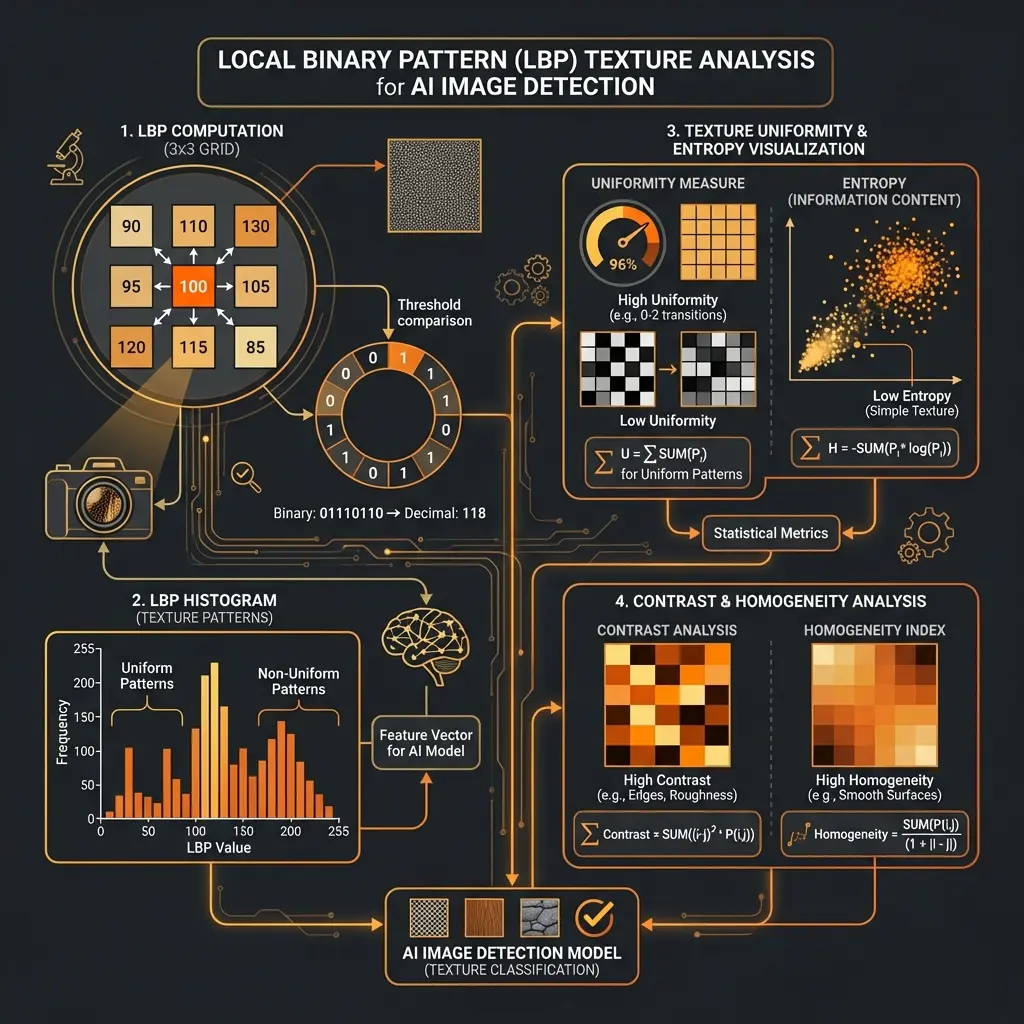
Local Binary Patterns (LBP)
How LBP Works
LBP compares each pixel with its surrounding neighbors. If a neighbor is greater than or equal to the center pixel, it gets a 1; otherwise, it gets a 0. The resulting binary pattern encodes local texture information.
This creates a histogram of texture patterns that is rotation-invariant and robust to illumination changes.
  5   6   8
  4  [6]  9    → Binary: 01110001 → Decimal: 113
  2   7   3
Example: Center pixel = 6, neighbors compared clockwise
Texture Metrics
LBP Uniformity
Measures how uniform the LBP histogram is. AI images often show abnormally high uniformity due to synthetic texture generation.
LBP Entropy
Calculates the information entropy of the LBP histogram. Lower entropy indicates less texture variety, common in AI-generated content.
Texture Contrast
Measures local contrast in the texture. AI images tend to have different contrast patterns compared to real photos captured by cameras.
Texture Homogeneity
Evaluates the smoothness of texture transitions. AI generators often produce unnaturally smooth or overly uniform texture areas.
Technical Details
LBP Parameters
- • Radius: 1 pixel (default)
- • Neighbors: 8 sampling points
- • Histogram bins: 256
- • Gray-level co-occurrence matrix (GLCM)
AI Indicators
- High LBP uniformity (> 0.35)
- Low entropy (< 4.5)
- Abnormal contrast distribution
- Excessive homogeneity (> 0.8)
関連方法
ML検出
数百万の画像で訓練された最先端のTransformerモデルを使用して、本物の写真とAI生成コンテンツを区別します。
PRNU分析
Photo Response Non-Uniformity (PRNU) detects unique camera sensor fingerprints from manufacturing imperfections. AI images cannot replicate these authentic sensor signatures.
周波数分析
DCT(離散コサイン変換)を用いて画像の高周波・低周波成分の分布を分析。AI生成画像はカメラで撮影された写真に存在する自然な高周波ノイズが欠如しており、この特徴で真偽を判定します。無料オンラインツール。
勾配分析
Analyzes edge patterns and texture characteristics using Sobel, Canny, and Laplacian operators. AI images often have unnaturally smooth or uniform gradients.
ノイズパターン
Real photographs contain unique noise patterns from camera sensors that vary across the image. AI-generated images have unnaturally uniform noise distribution.
メタデータ分析
Image metadata contains valuable clues about its origin. We analyze EXIF data, software signatures, and other embedded information to identify AI generation tools.
GANフィンガープリント
GAN(敵対的生成ネットワーク)が生成する画像のチェッカーボードパターン、カラーバンディング、スペクトル異常などの固有アーティファクトを高精度で検出。StyleGAN、ProGAN、CycleGAN対応の無料オンライン分析ツール。
Anatomy Detection
AI image generators often create anatomical errors that humans immediately recognize as wrong. We use computer vision to detect these telltale mistakes.
C2PA Verification
C2PA (Coalition for Content Provenance and Authenticity) is an industry standard for tracking the origin and history of digital content through cryptographic signatures.
Semantic Inconsistency Detection
Detects logical inconsistencies like incorrect shadows, impossible perspectives, distorted reflections, and violations of physical laws that AI often produces.
Human Biometric Analysis
Uses MediaPipe to analyze human anatomy for incorrect finger counts, asymmetric eyes, unnatural skin texture, and other anatomical anomalies common in AI-generated faces.
Lighting Physics Validation
Validates light source consistency, shadow direction physics, specular highlight accuracy, and color temperature uniformity across the image.
Compression Artifact Analysis
Analyzes JPEG compression artifacts to estimate quality levels and detect re-compression patterns that indicate image manipulation or AI generation.
Edge Sharpness Analysis
Analyzes sharpness distribution across the image and validates depth-of-field consistency. AI often produces unnaturally uniform sharpness.
Statistical Pattern Analysis
Analyzes statistical properties including Shannon entropy, histogram patterns, and Benford's Law compliance to detect synthetic image characteristics.
Chromatic Aberration Analysis
Detects the absence of chromatic aberration (color fringing) that real camera lenses produce. AI images lack these optical artifacts.
Micro-Texture Analysis
Analyzes microscopic texture patterns for repetition, uniformity, and unnatural randomness that AI generators often exhibit.
Color Palette Analysis
Analyzes color distribution including saturation levels, color diversity, and white balance consistency. AI images often have oversaturated colors.
画像をチェック
All methods are combined using weighted scoring to produce a final verdict with confidence level.
今すぐ試す