GAN Fingerprint Detection
Détection d'artefacts
Generative Adversarial Networks (GANs) leave distinctive fingerprints in the images they create. Our GAN Fingerprint detector analyzes multiple characteristics that are typical of GAN-generated content.
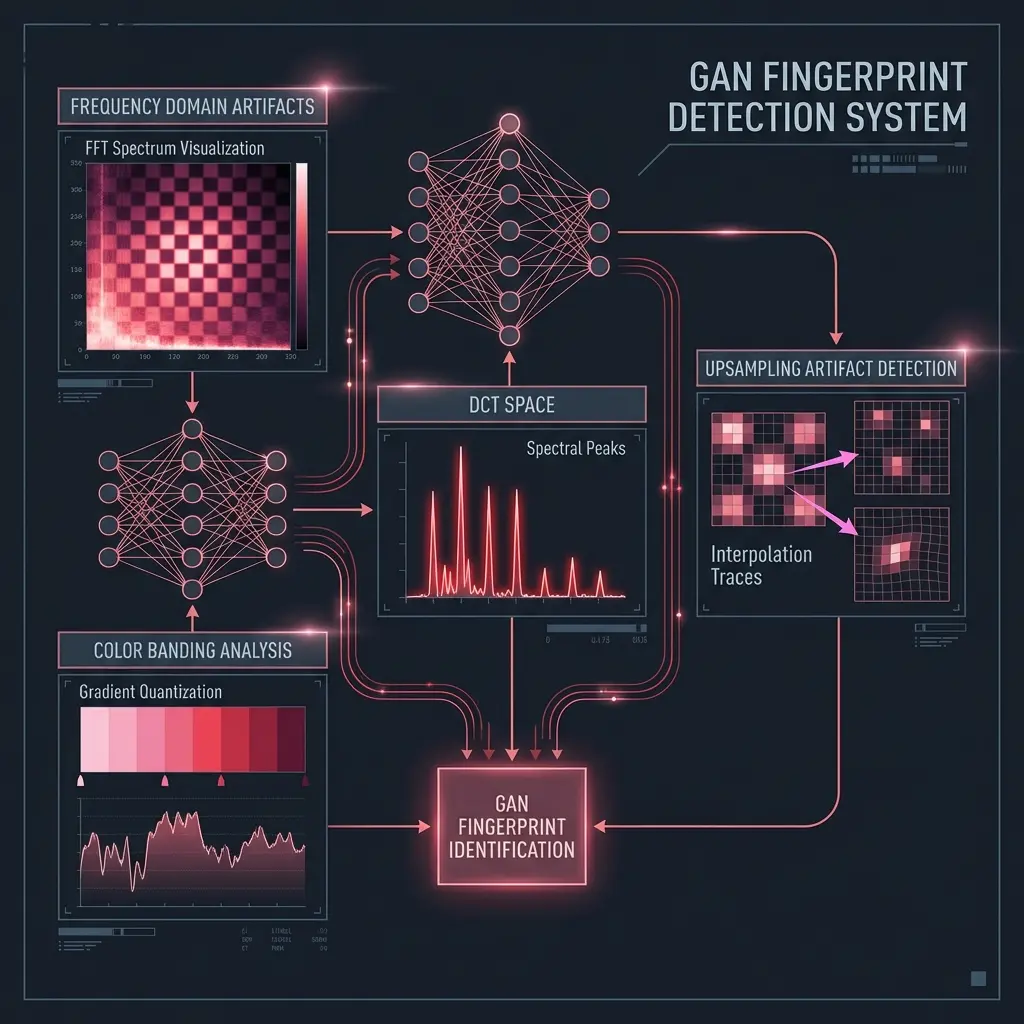
How It Works
These fingerprints arise from the mathematical operations used in GAN architectures, particularly upsampling layers and the generator network architecture.
Detection Methods
Checkerboard Pattern Detection
Transposed convolution layers in GANs often create checkerboard artifacts - periodic patterns visible in the frequency domain. We detect these using FFT analysis.
Color Banding Analysis
GANs often produce subtle color bands in smooth gradients due to limited color precision. We analyze gradient regions for unnatural color transitions.
Spectral Anomaly Detection
GAN images show unusual peaks in their frequency spectrum. We analyze the DCT spectrum for distinctive GAN signatures that differ from natural images.
Upsampling Artifact Detection
GAN generators use upsampling to increase image resolution. This process creates periodic artifacts that we detect using autocorrelation analysis.
Technical Details
GAN Artifacts We Detect
- Checkerboard patterns from transposed convolution
- Periodic patterns at specific frequencies
- Color quantization in smooth gradients
- Unnatural spectral energy distribution
GAN Types Detected
- StyleGAN / StyleGAN2 / StyleGAN3
- ProGAN / BigGAN
- DCGAN variants
- CycleGAN / Pix2Pix
Méthodes associées
Détection ML
Notre détection ML utilise des modèles Transformer entraînés sur des millions d'images.
Analyse PRNU
Photo Response Non-Uniformity (PRNU) detects unique camera sensor fingerprints from manufacturing imperfections. AI images cannot replicate these authentic sensor signatures.
Analyse Fréquentielle
L'analyse du domaine fréquentiel examine la distribution des composantes haute et basse fréquence d'une image. Les images générées par IA manquent généralement du bruit naturel haute fréquence présent dans les vraies photographies.
Analyse de gradient
Analyzes edge patterns and texture characteristics using Sobel, Canny, and Laplacian operators. AI images often have unnaturally smooth or uniform gradients.
Motif de bruit
Les vraies photographies contiennent des motifs de bruit uniques des capteurs de caméra qui varient à travers l'image. Les images générées par IA ont une distribution de bruit anormalement uniforme.
Analyse des métadonnées
Les métadonnées d'image contiennent des indices précieux sur son origine. Nous analysons les données EXIF, les signatures logicielles et autres informations intégrées pour identifier les outils de génération IA.
Analyse de texture
Analyse Local Binary Pattern pour les anomalies de texture dans les images IA.
Détection Anatomique
Les générateurs d'images IA créent souvent des erreurs anatomiques que les humains reconnaissent immédiatement comme fausses. Nous utilisons la vision par ordinateur pour détecter ces erreurs révélatrices.
Vérification C2PA
C2PA (Coalition for Content Provenance and Authenticity) est un standard industriel pour suivre l'origine et l'historique du contenu numérique via des signatures cryptographiques.
Semantic Inconsistency Detection
Detects logical inconsistencies like incorrect shadows, impossible perspectives, distorted reflections, and violations of physical laws that AI often produces.
Human Biometric Analysis
Uses MediaPipe to analyze human anatomy for incorrect finger counts, asymmetric eyes, unnatural skin texture, and other anatomical anomalies common in AI-generated faces.
Lighting Physics Validation
Validates light source consistency, shadow direction physics, specular highlight accuracy, and color temperature uniformity across the image.
Compression Artifact Analysis
Analyzes JPEG compression artifacts to estimate quality levels and detect re-compression patterns that indicate image manipulation or AI generation.
Edge Sharpness Analysis
Analyzes sharpness distribution across the image and validates depth-of-field consistency. AI often produces unnaturally uniform sharpness.
Statistical Pattern Analysis
Analyzes statistical properties including Shannon entropy, histogram patterns, and Benford's Law compliance to detect synthetic image characteristics.
Chromatic Aberration Analysis
Detects the absence of chromatic aberration (color fringing) that real camera lenses produce. AI images lack these optical artifacts.
Micro-Texture Analysis
Analyzes microscopic texture patterns for repetition, uniformity, and unnatural randomness that AI generators often exhibit.
Color Palette Analysis
Analyzes color distribution including saturation levels, color diversity, and white balance consistency. AI images often have oversaturated colors.
Vérifier Votre Image
Toutes les méthodes sont combinées en utilisant un score pondéré pour produire un verdict final avec niveau de confiance.
Essayer Maintenant